Triton TRA001 Review: The Router Built for the Router Table
The Triton TRA001 does something no other router at this price does: it lets you change bits and adjust depth from above the table without removing the router. That one feature changes the entire workflow.

Affiliate Notice: This guide contains affiliate links. We earn a commission if you buy through these links. See our disclosure.
Quick Verdict
- The Triton TRA001's above-table bit change is not a gimmick — it's a workflow transformation. For anyone running a router table, it's the most useful feature in a production router at this price. The 3.25HP motor handles everything. The weight and size make it less ideal for freehand work.
I bought the Triton TRA001 to live in a router table permanently — a dedicated machine for raised panel doors and decorative edge profiles that would never leave its mount. What I didn't fully appreciate before buying it was the above-table bit change. I understood it conceptually. I didn't understand how much the absence of this feature on my previous router had been slowing me down until I had it.
Here's the review after two-plus years of regular table routing.
What Does Above-Table Bit Change Actually Mean?
In a standard router table setup, the router hangs below the table surface, motor down, with the collet facing up through a hole in the table insert. Changing a bit requires:
- Reaching under the table and releasing the table insert
- Lifting the insert or tilting the router to access the collet
- Using two wrenches (or the shaft lock) to loosen the collet
- Removing the bit, inserting the new one, re-tightening with both wrenches
- Reinserting and latching the insert plate
- Adjusting the bit height from above
On a fixed-base router, this takes two to four minutes every time you switch bits. On a job where you're running multiple profiles — a raised panel, then a back groove, then an edge roundover — that's 10–15 minutes of tool changes per workpiece. In a production run of 20 doors, that's time.
The Triton TRA001 has a winding shaft that extends through the table top. To change bits on the TRA001:
- Turn the winding shaft knob to drop the router to max depth
- Access the collet from above through the table insert hole
- Use the included bit-change wrench from above to release and swap bits
- Wind the router back up to your working height
Total time: under 90 seconds. No reaching, no tilting, no second wrench.
How Does the Micro-Winder Depth Adjustment Work?
The micro-winder is the second feature that makes this router transformative for table use. On the top of the router, a knurled knob turns the router's plunge mechanism in extremely fine increments — approximately 1/100 inch per graduation. You raise and lower the bit while the router is table-mounted, adjusting to your target bit height without any of the awkward reach-under adjustments required on other routers.
For raised panel work where you're sneaking up on the final profile depth in 1/64-inch increments and test-cutting after each adjustment, this feature alone justifies the price premium over a Bosch 1617.
Best For
- Router table work with frequent bit changes — raised panels, cope-and-stick, multi-profile runs
- 1/2-inch shank bits where 3.25HP prevents any chance of bogging
- Woodworkers who build cabinet doors, face frames, and furniture with consistent edge profiles
- Anyone who wants a single router that handles both table and freehand use (with the right setup)
Is 3.25HP Actually Necessary?
For the work most woodworkers do, no — a 1.75HP or 2HP router handles dadoes, roundovers, and most edge profiles without issue. But there are specific applications where the TRA001's 3.25HP motor is the difference between clean work and fighting the tool:
Raised panel profiles with large-diameter bits: A full raised panel bit (2.5–3 inches diameter) at maximum depth in one pass requires the motor to push air and material at a rate that bogs a smaller router. The TRA001 handles full-depth raised panel profiles in a single pass through 3/4-inch hardwood without hesitation. A 1.75HP router will complete the same cut but more slowly and with more burning risk.
Full-depth mortise and groove work: Plowing a 1/2-inch groove in 3/4-inch hardwood in a single pass is where smaller routers struggle. The TRA001 doesn't slow down.
For trim routing, flush-trimming, and simple edge profiles on furniture parts, you're overpaying for the motor if table routing isn't your primary use. The Bosch GKF125CEK trim router at $80 is the right tool for freehand trim work.
How Does It Perform Handheld?
Honestly — it's not great handheld. The TRA001 weighs 13.2 pounds. After 20 minutes of freehand routing, your forearms know it. The large base limits access to inside corners and tight template work.
For tasks where handheld routing is unavoidable — mortising hinges, routing template profiles on curved parts — I switch to a compact router. The DeWalt DWP611 is what I reach for. The Triton stays in the table.
If you're buying a router for primarily freehand work, the TRA001 is not the right tool. Look at the Bosch 1617EVSPK (2-1/4HP, plunge + fixed base combo) or the DeWalt DWP611PK for a more balanced handheld-and-table router.
Skip If
- Your routing is primarily freehand — the 13-lb weight makes it exhausting over time
- You don't have a router table — the above-table features are useless without one
- You're on a tight budget — the Bosch 1617 combo kit at $50–70 less is capable without the above-table features
Table Compatibility and Insert Plate
The TRA001 requires an insert plate that fits its base diameter (214mm). Most router tables include either a standard Triton-pattern plate or a universal insert with pre-drilled holes. Verify your table's insert plate compatibility before ordering.
The winding shaft protrudes about 2 inches above the table — this is the mechanism for above-table adjustment, and it sits within the table's insert opening. Some aftermarket plates have insufficient clearance for the winding shaft. Triton sells a compatible plate separately, or check your table manufacturer's TRA001-specific plate.
How Does It Compare to the Bosch 1617EVSPK?
The Bosch 1617EVSPK is the closest direct competitor: a 2.25HP router with fixed and plunge base, at $140–$160 street. The comparison:
Triton TRA001 wins on: Above-table bit change (no contest), motor power, and above-table depth adjustment. For dedicated table routing, it's not close.
Bosch 1617 wins on: Better handheld balance, lower price, and a plunge base that's smoother for freehand mortising. If you're equally split between table and handheld, the Bosch is the more versatile single router.
For a full comparison, see our router comparison page.
Frequently Asked Questions
Does the TRA001 fit in a standard router table insert plate? The TRA001 uses a 3-hole mounting pattern with a 214mm base. Most aftermarket router plates (Rockler, MLCS, Lee Valley) are available in TRA001-compatible versions. Verify before ordering — not all universal plates include the winding shaft clearance hole.
Is the 1/2-inch collet included? Yes. Both 1/4-inch and 1/2-inch collets are included with the TRA001. Use 1/2-inch shank bits whenever available — they run more smoothly, are more stable, and produce less vibration at high RPM with large-diameter bits.
Can I use it for handheld plunge routing? Yes — the TRA001 is a full plunge router with 2-9/16 inch plunge depth. The plunge action is heavier than a Festool or Bosch due to the motor weight. Functional, but not precise enough for fine joinery where a lighter router's plunge resistance matters.
Does it have a soft-start? Yes. The TRA001 ramps to full speed over about 1.5 seconds rather than lurching at full torque immediately. At 3.25HP, soft-start is not optional — the torque reaction at full-power startup would be difficult to control without it.
Bottom Line
The Triton TRA001 is the best dedicated table router at its price. The above-table bit change and micro-winder depth adjustment transform router table workflow in ways that are obvious after the first session. The 3.25HP motor handles everything you can put in front of it.
If your router spends most of its time in a table, this is the router to buy. If you split time equally between table and handheld, the Bosch 1617EVSPK is the more practical all-rounder. Use our tool finder to compare routers by power and use case.
Shop Triton TRA001 Router on Amazon↗You Might Also Like
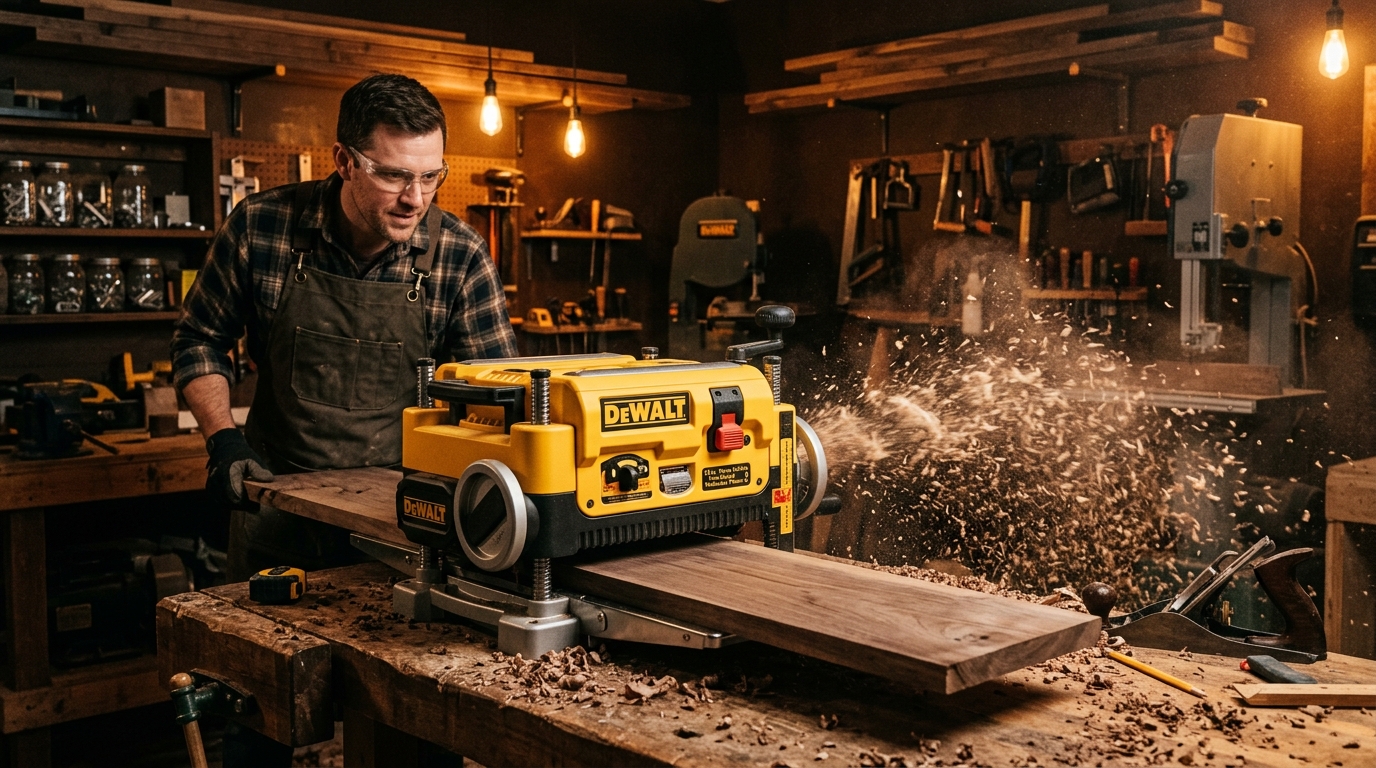
DeWalt DW735X 13-Inch Planer Review: The Bench Planer Most Woodworkers Should Own
The DeWalt DW735X is a 13-inch, two-speed benchtop planer with a three-knife cutter head that handles hardwood surfacing without hesitation. Here's how it performs in a working shop.

DeWalt DWP611PK Compact Router Review: The Fixed/Plunge Combo That Actually Works
The DeWalt DWP611PK gives you a fixed base and plunge base for $169 — making it one of the best-value router setups for woodworkers who want versatility without spending $300+.

WEN 4214T 12-Inch Drill Press Review: The Best Budget Drill Press You Can Actually Buy
The WEN 4214T is a 12-inch variable speed benchtop drill press with laser, LED, and cast iron construction for under $200. Here's how it holds up in a real shop.