The Ultimate Beginner Woodworking Loot Kit: Everything You Need to Start
Most beginner woodworking guides tell you to buy a table saw first. That's wrong. This kit starts with the three tools that handle 80% of beginner projects — then builds up through three tiers from $350 to $1,200.

Affiliate Notice: This guide contains affiliate links. We earn a commission if you buy through these links. See our disclosure.
The most common advice given to woodworking beginners is also the most wrong: "Start with a table saw."
A table saw is a $400–$800 machine that takes up 16 square feet of floor space, requires a dedicated circuit, and will terrify you the first twelve times you use it. It's also the most common serious injury tool in the workshop (CPSC, 2024 — table saws account for roughly 33,000 emergency room visits per year in the US).
You don't need a table saw to start woodworking. You need three tools.
TL;DR: A circular saw, cordless drill, and random orbital sander — total $350 at the Starter tier — handle the majority of beginner woodworking projects. Add a miter saw at $700 for accurate cross-cuts. Add a router at $1,200 to open up edge profiling, joinery, and decorative work.
The Beginner's Real Problem: Not Tools, But Sequence
The woodworking community has a supply problem and a sequencing problem. YouTube tutorials demonstrate techniques on $10,000 shop setups. Beginner guides recommend $6,000 worth of tools on page one. Most beginners buy a miter saw, make four cuts, and quit — because a miter saw alone can't build anything. You also need a way to rip sheet goods, a drill to assemble parts, and a sander to finish them.
The sequence that works:
- Buy the three core tools first
- Build a project using only those tools
- Identify the gap that's slowing you down
- Buy the tool that fills that specific gap
This kit is structured around that sequence.
A table saw handles sheet goods ripping — the 56% use case. A circular saw handles it adequately for most beginner projects and covers the other 90% tasks a table saw cannot do at all.
Tier 1 — The Starter Kit (~$350)
Three power tools plus four hand tools and accessories. This is the minimum viable woodworking kit — not the minimum, but the minimum that can actually complete a project.
Circular Saw (6.5-inch Cordless)
The circular saw is the most important tool in this kit. It cross-cuts lumber to length, rips plywood panels to width (with a straightedge guide), and handles both dimensional lumber and sheet goods.
The 6.5-inch blade size handles all lumber up to 1.5 inches thick in a single pass at 45 degrees and 2.25 inches at 90 degrees — covering every 2x lumber you'll encounter. Pair it with a Kreg Rip-Cut or a simple straightedge clamped to the sheet for accurate rips.
If you're choosing a cordless platform, commit here. All subsequent tools should share your battery.
DeWalt 20V MAX 6.5-Inch Circular Saw on Amazon↗Cordless Drill/Driver (with Batteries)
Assembly without a drill is misery. The drill holds everything together — pilot holes to prevent splitting, driving screws for joinery, boring holes for pocket jigs. Buy the combo kit with two batteries.
DeWalt 20V MAX Drill/Driver Kit (2 Batteries) on Amazon↗Random Orbital Sander (5-inch)
Sanding makes or breaks a woodworking project. The difference between 80-grit rough stock and 220-grit finished surface is the difference between "rough DIY" and "actually nice." A random orbital sander produces a scratch-free, swirl-free surface when you work through the grits — 80, 120, 180, 220.
The Makita BO5041 is the standard recommendation at this price range. Variable speed, reliable pad, excellent dust collection. Start here and don't look at another sander until this one dies.
Makita BO5041 5-Inch Random Orbital Sander on Amazon↗Combination Square (12-inch)
Woodworking accuracy lives and dies with your layout tools. A combination square marks 90-degree and 45-degree lines, measures depth, and checks whether your cuts are actually square. Empire's 12-inch version is consistent and inexpensive.
Empire 12-Inch Combination Square on Amazon↗Irwin Quick-Grip Clamps (2-pack, 6-inch)
Clamps are work-holding. Without them you're trying to drill while holding the board, which produces crooked holes and frustration. Start with two 6-inch Quick-Grips — they hold boards for drilling, hold glue joints while they cure, and function as a third hand on every project.
Irwin Quick-Grip 6-Inch Clamps (2-Pack) on Amazon↗Starter Kit Handles
- Simple shelving units from 1x lumber
- Workbenches and sawhorse builds
- Outdoor furniture (Adirondack chairs, planters, deck boxes)
- Basic cabinet boxes and storage crates
- Floating shelf brackets and wall-mounted shelving
The circular saw replaces both the miter saw and the table saw at the beginner level — imperfectly, but adequately. A clamp-on straightedge for rips and a speed square for crosscut guides handle 80% of what a full shop does. Learn the circular saw first. Add the specialty saws once you've outgrown the workaround.
Tier 2 — The Complete Kit (~$700)
The Complete tier adds precision and speed for the one task where a circular saw underperforms: repetitive, accurate crosscuts of the same measurement. Every time you need to cut multiple boards to identical lengths, a miter saw earns its place.
10-Inch Compound Miter Saw
A miter saw doesn't expand what you can build — it makes it faster and more accurate to build. Repeat crosscuts to the same length, clean 45-degree miter joints for frames and trim, bevel cuts for angled assemblies. DeWalt's DW713 is the standard single-bevel 10-inch recommendation at this price range: accurate, durable, and widely supported by aftermarket accessories.
A miter saw requires a flat, stable surface. A pair of sawhorses and a sheet of plywood work fine for a temporary setup. If you're setting up a dedicated space, mount it on a rolling stand.
DeWalt DW713 10-Inch Single Bevel Miter Saw on Amazon↗Kreg Pocket Hole Jig
Pocket hole joinery is the fastest way to assemble face frames, cabinet boxes, and furniture parts with a joint that's strong enough for most furniture applications. The Kreg R3 mini jig is the right entry point — simple, portable, and teaches you the technique without a large investment.
Kreg R3 Pocket Hole Jig on Amazon↗Bessey EHKM Clamp Set (4-piece)
By the Complete tier, the two Quick-Grips from Tier 1 aren't enough. Bessey's F-style clamps apply significantly more clamping force than the spring clamp style — important for edge-gluing panels and holding larger assemblies together. A 4-piece set in mixed sizes covers most projects.
Bessey Steel Bar Clamp Set on Amazon↗Woodworking as a hobby grew significantly during and after 2020, with the Woodworkers Guild of America reporting over 2.1 million new hobbyist woodworkers joining the community since 2020. The demand for entry-level guidance has never been higher — and neither has the amount of bad beginner advice online.
Complete Kit Adds
- Face frames and cabinet boxes with pocket hole joinery
- Repeat crosscuts to consistent lengths for furniture and shelving
- 45-degree miter joints for frames and decorative trim
- Edge-glued panels for tabletops and wider boards
Tier 3 — The Pro Kit (~$1,200)
The Pro tier adds the two tools that separate a basic shop from a genuinely capable one: a router for edge profiling, slots, and decorative work, and a bench vise for stable hand-tool work and assembly.
Palm Router Kit (1.25 HP)
A trim router does three things that transform beginner projects into furniture-grade work: rounds over sharp edges with a roundover bit, cuts dadoes and grooves for shelf pins and panel grooves, and templates with a flush-trim bit to replicate identical parts.
The Bosch GKF125CEK is the best all-around compact router at this price. The kit includes the base, edge guide, and a set of bits — enough to start immediately. The Bosch base accepts most standard 1/4-inch shank bits.
Bosch GKF125CEK Palm Router Kit on Amazon↗Bench Vise (4-inch or 5-inch)
A bench vise is work-holding for everything that clamps can't hold: planing boards, chopping mortises, filing, and hand-saw work. Mount it to a thick workbench or to a sheet of 3/4-inch plywood clamped to sawhorses. The Yost LV-4 is a cast-iron, parallel-jaw vise that punches well above its price.
Yost LV-4 4-Inch Compact Bench Vise on Amazon↗Sanding Disc and Sheet Assortment
By the Pro tier, you're finishing real furniture — which means working through grits systematically and keeping the sandpaper stocked. A mixed assortment of 5-inch hook-and-loop discs covers the random orbital, and a sheet pack covers hand-sanding detail work.
Diablo 5-Inch ROS Sanding Discs Assortment on Amazon↗Pro Kit Adds
- Rounded over and profiled edges on tables, shelves, and furniture
- Dado grooves for cabinet shelf pins and panel grooves
- Template routing to replicate identical parts
- Stable hand-tool work at the bench
What Should You Buy First?
The sequencing question everyone has and almost no guide answers honestly:
If you're building shelving or storage: Start at Tier 1. A circular saw, drill, and sander handle this category completely.
If your first project is a workbench or furniture: Start at Tier 1 and add the miter saw (Tier 2) at the same time. Furniture requires repeated crosscuts to identical lengths. The miter saw pays for itself on the first project.
If you want to build cabinet boxes: You need both the circular saw (for plywood ripping) and the pocket hole jig (for face frame joinery). Buy both.
Skip This Kit If...
- Your woodworking goal is hand-tool only (planes, chisels, mallets) — this kit is power-tool oriented
- You don't have a garage, shed, or outdoor space — circular saws and miter saws are not apartment tools
- You're building very large projects requiring a table saw for frequent ripping — add a track saw instead
The biggest mistake beginners make is buying a miter saw before a sander. A miter saw makes the cut faster. A sander makes the project actually look good. If you're forced to choose between the two, get the sander.
Frequently Asked Questions
Do I really not need a table saw?
For the first six months to a year of woodworking: no. A circular saw with a straightedge guide makes rips in plywood that are accurate to within 1/32 inch — better than most hobbyists need and good enough for furniture-grade work. A table saw is faster for repetitive ripping. Add one when speed becomes a bottleneck, not when you're buying your first tools.
Is cordless as good as corded for a circular saw?
For beginner woodworking projects — cutting in the garage, cutting outside, moving material — yes. A brushless cordless circular saw matches corded performance for all dimensional lumber and 3/4-inch sheet goods. You'll notice a difference only in very long production runs on heavy material.
What's the best beginner woodworking project?
A simple wall shelf. It requires every core skill — measuring, crosscutting to length, drilling pilot holes, driving screws, and sanding — without complex joinery or large material. Build three of them and you'll understand your tools well enough to know what to buy next.
How much does a proper lumber supply cost for a first project?
A typical beginner furniture project (bench, small table, planter box) uses $40–$80 worth of dimensional lumber from a home center. Use construction lumber — No. 2 pine or #2 SPF — not hardwoods until you know how the tools handle different species.
When should I add a track saw instead of a table saw?
If you're working in a small space and process a lot of sheet goods (plywood, MDF), a track saw is often the better upgrade. It does the same job as a table saw for ripping sheets, stores on a wall hook, and costs $400–$600 for a solid mid-range option. Table saws win on speed for repetitive small-part work. Track saws win on portability and space.
Start Narrow, Go Deep
The worst thing a beginner woodworker can do is buy tools for a fantasy shop and then build nothing. The best thing is to buy the three tools in the Starter tier, build something with them — something real, even if it's imperfect — and let the project tell you what tool to buy next.
The Starter kit at $350 is enough to build furniture. The Complete kit at $700 is enough to build cabinetry. The Pro kit at $1,200 opens up a full range of furniture-grade work. Start at the level that matches your next project, not your aspirations for the whole shop.
Compare cordless platforms before committing your battery ecosystem — see the Milwaukee vs DeWalt vs Ryobi vs Makita comparison or use the tool finder to match tools to your budget and use case. If you're building out a broader shop at a fixed budget, see the $500 workshop starter plan.
You Might Also Like
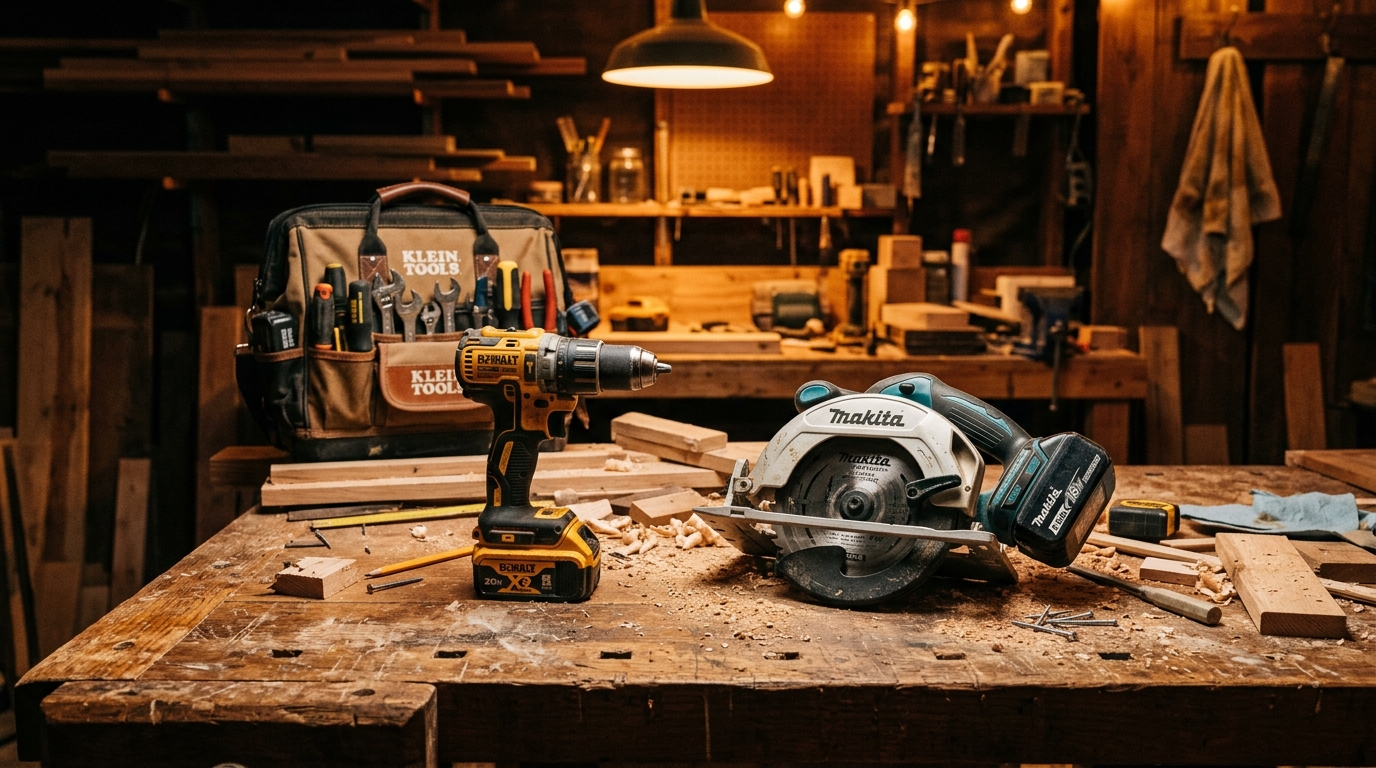
The Weekend Warrior Loot Kit: Power Tools for Casual DIYers
Most DIY projects need fewer tools than you think — but the right ones. This kit builds out in three tiers from $200 to $700, covering 80% of weekend projects without paying for gear you'll use twice.
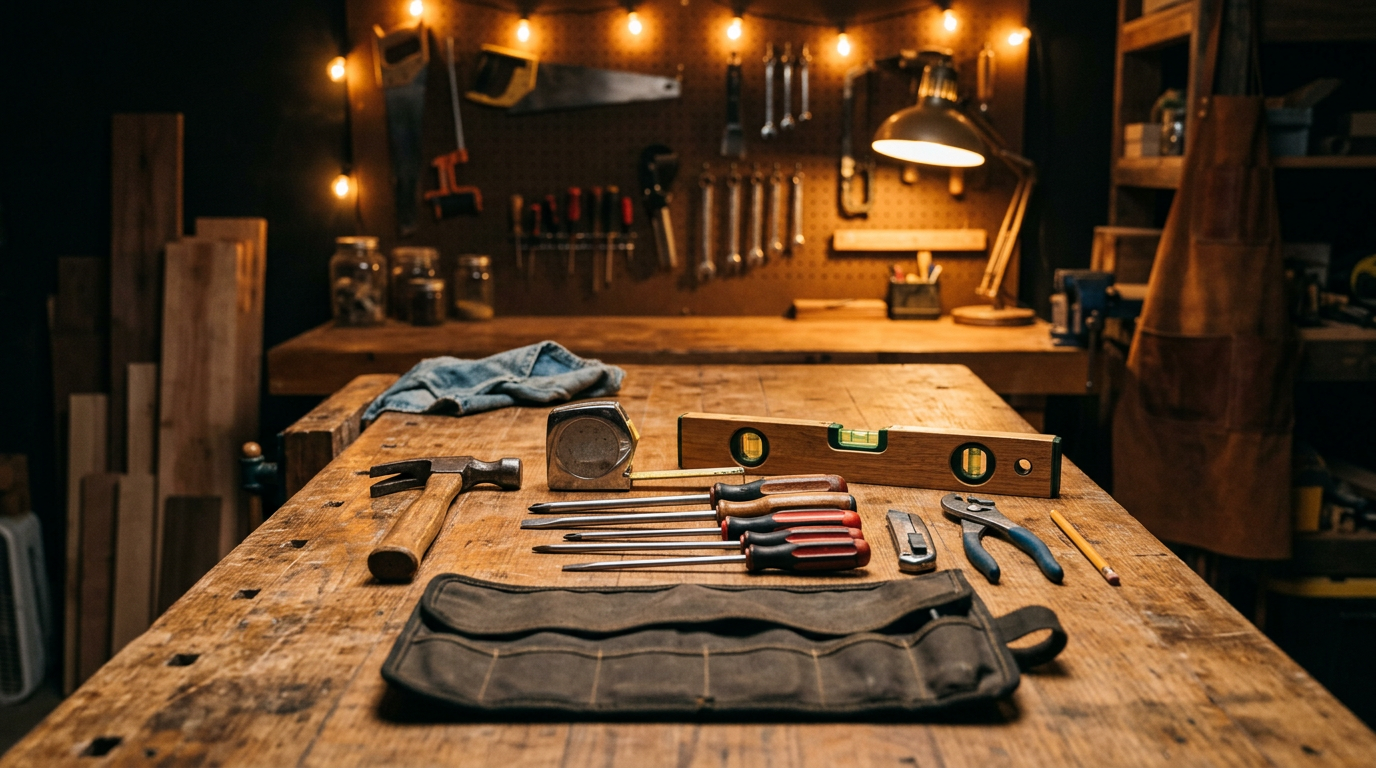
The New Homeowner Starter Loot Kit: First Tool Set
92% of new homeowners hit a surprise repair in their first year. This kit gives you the 10 tools that handle most of them — organized into three budget tiers from $150 to $450.