The Weekend Warrior Loot Kit: Power Tools for Casual DIYers
Most DIY projects need fewer tools than you think — but the right ones. This kit builds out in three tiers from $200 to $700, covering 80% of weekend projects without paying for gear you'll use twice.

Affiliate Notice: This guide contains affiliate links. We earn a commission if you buy through these links. See our disclosure.
According to Angi's 2025 State of Home Spending Pulse Report, 71% of homeowners plan to take on DIY projects this year (Angi, 2025). Most of them will stall out not because the project is too hard — but because they bought the wrong tool first.
The classic mistake: buying a tool set designed for a professional who uses tools eight hours a day. The weekend warrior equivalent of that is paying $1,200 for a full platform kit when two tools handle 90% of your actual projects.
This kit is designed backwards from the projects, not from the tool catalog.
TL;DR: A cordless drill and a set of basic hand tools covers most first-year DIY. Add a circular saw for any cutting work and a jigsaw plus sander for finish projects. Three tiers, $200 to $700, and you're covered for everything from building a deck box to installing floating shelves.
What the Weekend Warrior Actually Builds
Before we get into the kit, it helps to know what "weekend warrior" projects actually look like. Based on frequency data from DIY community surveys and Angi's project cost reports, the most common projects are:
Every one of those projects requires a drill. Most of them require some form of cutting. A handful need sanding for a clean finish. That's the entire logic behind this three-tier kit.
Tier 1 — The Starter Kit (~$200)
A cordless drill/driver combo kit plus four hand tools. This handles shelving, furniture assembly, basic repair work, and anything else that involves driving screws and knowing what's level.
Cordless Drill/Driver Combo Kit
The most important decision in this kit isn't which drill to buy — it's which battery platform to commit to. Every tool you add later should run on the same battery. Two platform choices make sense at the entry level:
Ryobi 18V ONE+ is the right call if you're cost-conscious and want a wide accessory ecosystem. There are over 300 ONE+ compatible tools, batteries are affordable, and Ryobi's PCL-series brushless models are meaningfully better than their older carbon-brush counterparts.
DeWalt 20V MAX is the better long-term investment if you expect to grow into more professional-grade tools. The ecosystem is larger at the top end, and you can cross-use batteries between DeWalt's 20V and 60V FLEXVOLT platforms as you scale up.
For a starter kit, either works. Buy the combo kit with two batteries and a charger — the second battery is not optional.
Ryobi 18V ONE+ Drill/Driver + Impact Driver Combo on Amazon↗ DeWalt 20V MAX Drill/Driver Kit (2 Batteries) on Amazon↗Stanley FatMax 25ft Tape Measure
The drill is useless without accurate measurement. The FatMax's wide blade stays rigid when extended solo — something you notice immediately when you're trying to measure a 16-foot deck span by yourself.
Stanley FatMax 25ft Tape Measure on Amazon↗Swanson Speed Square (7-inch)
Mark 90-degree cuts before every board or sheet. A speed square is also a straightedge for circular saw guides. It costs $12 and saves time on every single cut.
Swanson 7-Inch Speed Square on Amazon↗Safety Glasses + Ear Protection
Cordless circular saw generates 90+ dB at the operator's position. Repeated 90dB exposure for more than 8 hours causes hearing loss — and weekend warriors often run saws for 4–6 hours without thinking about cumulative exposure (CDC NIOSH, 2024). Budget $25 for both. Keep them in the tool bag.
3M Peltor Earmuffs on Amazon↗ 3M Safety Glasses on Amazon↗Starter Kit Handles
- Installing floating shelves and wall-mounted storage
- Building simple flatpack or raw-lumber furniture
- Deck and fence repairs (screws, not cutting)
- Mounting hardware, door handles, cabinet hinges
Most people underestimate how much a good combo kit can do before you need a saw. If you only have four screws to drive, using your phone to call a handyman costs more than the drill.
Tier 2 — The Complete Kit (~$450)
The Starter kit is great for screw-driving and assembly. The Complete kit adds cutting — which opens up framing, deck boards, plywood shelving, and any project requiring you to size lumber.
Cordless Circular Saw
A 6.5-inch cordless circular saw cuts through 2x dimensional lumber cleanly and handles 3/4-inch plywood. This is the tool that separates "I can mount it" from "I can build it."
If you're on the Ryobi platform, the brushless PCL series is the right buy — significantly more runtime than the older brushed models. If you're on DeWalt 20V, the DCS391B is the standard workhorse and runs on the same batteries from your drill.
DeWalt 20V MAX Circular Saw on Amazon↗ Ryobi 18V ONE+ Brushless Circular Saw on Amazon↗Folding Sawhorses (Pair)
You cannot cut safely with material balanced on your knee or a trash can. A pair of folding sawhorses at $40–$50 is the difference between a controlled cut and a dangerous one. Get two. Keep them in the garage.
DeWalt Folding Metal Sawhorses (Pair) on Amazon↗The average DIYer saves $2,128 annually versus hiring out the same projects (Puls, 2025). A $450 Complete kit pays for itself before the second deck project is done.
Complete Kit Adds
- Ripping plywood for shelving units
- Cutting deck boards and fence pickets to length
- Sizing framing lumber for outdoor structures
- Any project requiring custom-cut materials
Tier 3 — The Pro Kit (~$700)
The Pro tier turns a cutting-focused kit into a finishing-capable one. Two tools — a jigsaw and a random orbital sander — are responsible for most of the quality difference between "DIY-looking" and "actually nice."
Cordless Jigsaw
A jigsaw does what a circular saw can't: curves. Rounded corners on shelves, cut-outs for sinks and outlets, irregular shapes for outdoor projects — none of that is practical with a circular saw. The DeWalt DCS331B is compact and balanced; the Milwaukee M18 2737-20 is heavier but more powerful for thicker stock.
DeWalt 20V MAX Jigsaw on Amazon↗Random Orbital Sander
Sanding transforms the project. Before-and-after the same shelf with 120-then-220-grit is the difference between "looks homemade" and "looks bought." The Makita BO5041 is the industry-standard recommendation at this price point — 5-inch pad, variable speed, reliable dust collection.
Makita BO5041 5-Inch Random Orbital Sander on Amazon↗Tool Bag (24-inch Open-Mouth)
By the Pro tier, you have enough tools that loose storage in a bucket guarantees you can never find the right bit. The Stanley open-mouth bag keeps everything visible and portable. One bag, every tool, always ready.
Stanley 24-Inch Tool Bag on Amazon↗Pro Kit Adds
- Curved cuts for decorative shelving, furniture, and outdoor projects
- Smooth finish work on raw lumber before painting or staining
- Rounded cabinet corners, jig-sawn cutouts, and sink templates
Which Tier Should You Start With?
Skip This Kit If...
- You already own a cordless drill and circular saw on a battery platform you like
- You're outfitting for professional daily use — look at M18 FUEL or DeWalt FLEXVOLT
- You live in an apartment and have no place to use a circular saw
If your first project involves drilling and driving screws, start at Tier 1. It costs $200 and handles more than most people expect.
If your first project involves any lumber cutting — deck boards, plywood, framing — start at Tier 2 and get the circular saw and sawhorses from day one. Trying to work around not having a saw is more frustrating than the cost.
The Pro tier is worth it if you plan to finish and paint any project. Unsanded wood under latex paint looks rough at arm's length. Two passes with a random orbital sander costs 30 minutes and looks like a different project.
Frequently Asked Questions
Should I buy Ryobi or DeWalt for a first kit?
Ryobi ONE+ if you want lower initial cost and plan to stay casual. DeWalt 20V MAX if you think you'll grow into more tools or want compatibility with a wider professional ecosystem. Both make solid entry-level tools. Do not split batteries between platforms — that's where people go wrong.
Can I use the same batteries across all three tiers?
Yes — if you buy within the same platform. Ryobi 18V batteries work across all 300+ ONE+ tools. DeWalt 20V batteries work across the 20V MAX line and are backward-compatible with FLEXVOLT tools. Never mix brands.
Do I need a miter saw instead of a circular saw?
Not for a first kit. A circular saw with a speed square guide makes accurate crosscuts in 2x lumber. A miter saw is faster and more accurate for repeated cuts of the same length — but at $250–$400, it doesn't belong in a starter kit unless you know you'll need it for a specific project.
Is a cordless circular saw as powerful as a corded one?
For dimensional lumber (2x4, 2x6) and 3/4-inch plywood, a brushless cordless circular saw is equivalent in cutting performance. You'll notice the weight difference and the runtime limitation on a full day of heavy use — but for weekend projects, cordless is the right call.
What's missing from this kit?
A miter saw, a router, and any stationary power tools. This kit is intentionally portable — everything fits in a tool bag and runs off two batteries. If you're setting up a dedicated workshop space, add a 10-inch miter saw next. If you're doing finish carpentry, a trim router is the logical follow-on.
Build It in Stages, Not All at Once
The single biggest mistake weekend warriors make is buying the whole kit before they know which tools they'll actually use. The Starter tier at $200 is genuinely useful on its own. Add the saw when a cutting project shows up. Add the jigsaw and sander when you're ready to finish a project cleanly.
The tools that sit unused in the garage are the expensive ones — not the ones you bought because you needed them.
Ready to take the next step into dedicated woodworking? The beginner woodworking loot kit builds on this kit with precision cutting and finishing tools. Use the tool finder to compare circular saws by platform and budget, or see the cordless platform guide if you haven't committed to a battery system yet.
You Might Also Like
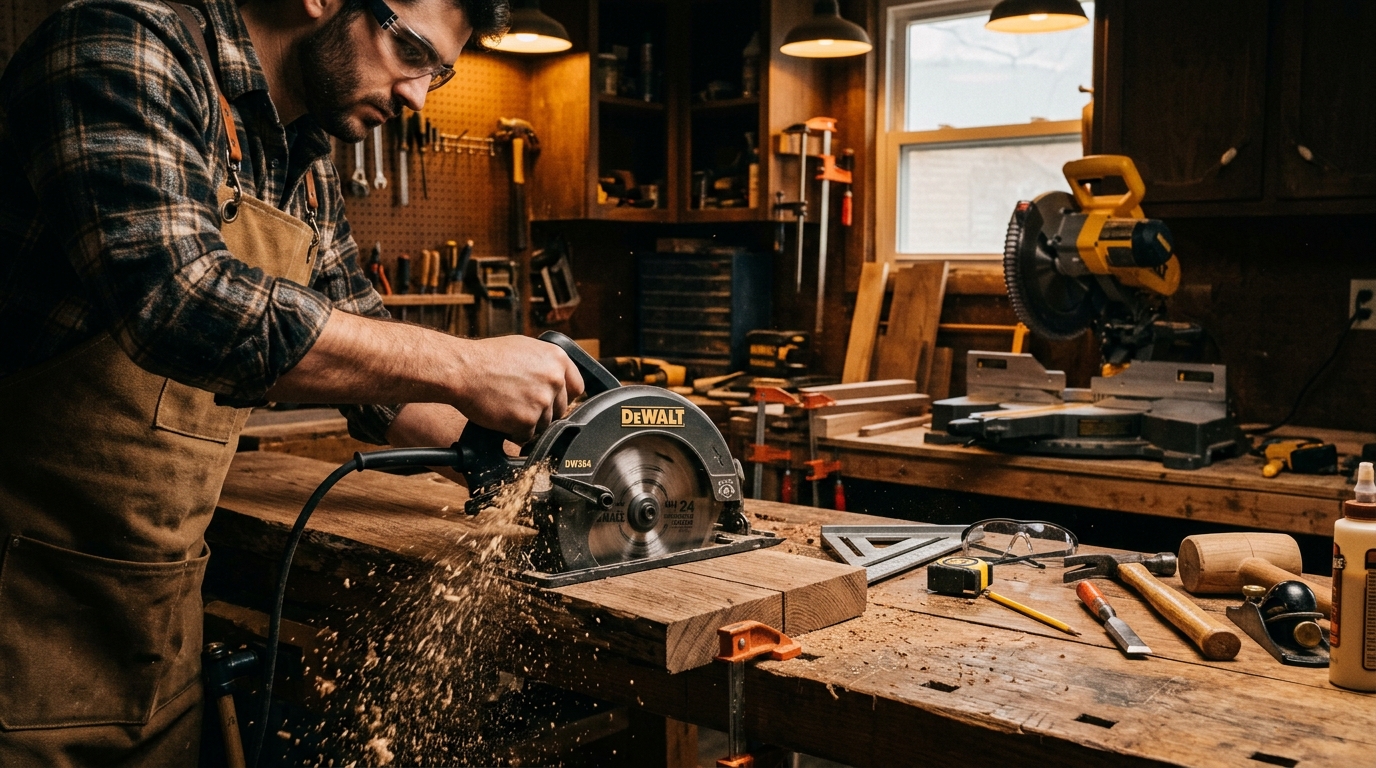
The Ultimate Beginner Woodworking Loot Kit: Everything You Need to Start
Most beginner woodworking guides tell you to buy a table saw first. That's wrong. This kit starts with the three tools that handle 80% of beginner projects — then builds up through three tiers from $350 to $1,200.
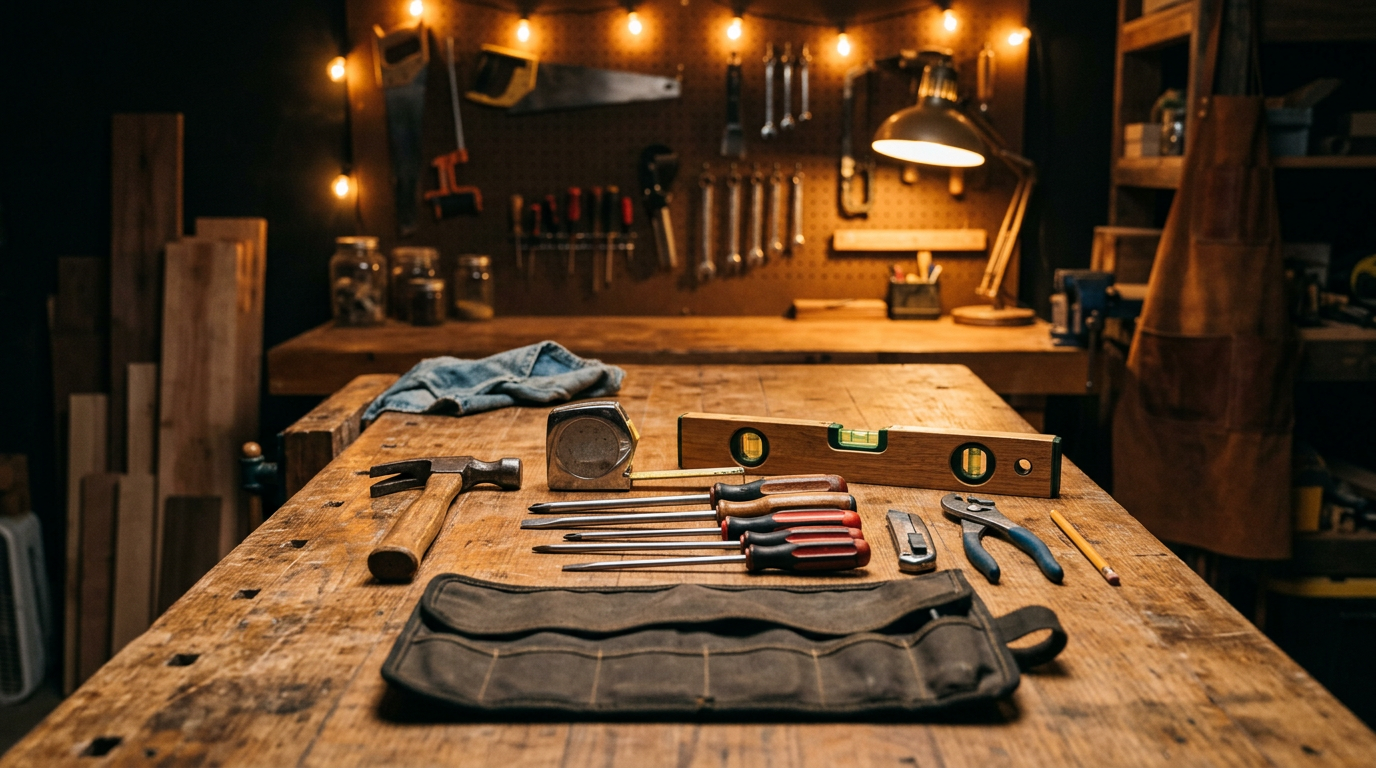
The New Homeowner Starter Loot Kit: First Tool Set
92% of new homeowners hit a surprise repair in their first year. This kit gives you the 10 tools that handle most of them — organized into three budget tiers from $150 to $450.